This is part of a series of essays commissioned by Paris-based DSLcollection and published by Art Industry Insights With Reena Devi, exploring the collection within the context of larger digital developments and international art collections.
The New-ish Wave Of Contemporary Creativity
One of the more tragic aspects of musician Kanye West’s divisive, controversy seeking antics is the shadow cast on his previously ground-breaking creative partnerships, heralding an era of merging fashion, art, music, and culture.
Back in February 2015, during the heyday of collaborations between West and artist Vanessa Beecroft, the musician’s fashion line for Adidas was unveiled at New York Fashion Week, with a Beecroft performance as its key highlight.
Then, there was the late Virgil Abloh, American fashion designer and entrepreneur. He landed his big break designing graphics and visual concepts for West, before becoming his artistic director. In 2013, Abloh launched Off-White, a brand associated with a new type of luxury, “intellectual, rebellious, and steeped in cultural references.”
Five years later, he made history as the first Black artistic director of Louis Vuitton’s menswear, becoming the very epitome of inclusivity, diversity, and cutting-edge innovation in fashion. Today, Abloh is described as “a creative architect of an era, rewriting the rules and blurring the lines between streetwear and luxury,” and a “true icon of contemporary creativity”.

Speaking with Vogue Business, Jeppe Ugelvig, a New York-based curator and fashion historian, shared, “While the fashion industry and fashion system used to be a relatively small, insidery business that had limited pop cultural appeal, since the rise of its media culture in the 70s, it’s become something that a lot of people can relate to.”
“Whether it’s fashion’s relationship to celebrity or to music, fashion is pop culture. And in that sense it has replaced the role of fine art. Looking back at something like pop art, there was a proximity between the media and fine art that felt very organic, and thus saw people streaming to these exhibitions. Nowadays, contemporary art, to many, feels quite niche, specialised, a little bit obscure as a cultural form. Fashion has really eclipsed art as a form of mass culture and mass entertainment,” he added.
However, there is a deeper reason for the entwining of art and fashion. Writing about fashion falling backwards for ArtReview, Rosalind Janna stated: “Though the fashion industry has always both rewarded and provoked cynicism, something about its current cycle feels particularly wearying. Everything scuds by on a screen, one ‘moment’ or microtrend swiftly supplanted by another. The pace is fast, the rewards sporadic, the artistry in low supply.”
“Cultural paralysis”, “aesthetic consolidation”, “the age of average”- these are some of the phrases used by designers, artists, writers, and thinkers to describe the evolution of style, fashion, visual culture, graphic design, and art in recent decades.
This ennui inadvertently led to a “growing appetite for more interdisciplinary approaches to creative practice, characterised by more porous definitions of art, fashion, architecture, design and beyond.”
The Art World Is All In (For The Money)

Last month saw the opening of ‘Louvre Couture’, a highly anticipated exhibition at Paris’ Louvre, showcasing couture masterpieces by Gabrielle Chanel, Cristóbal Balenciaga and Jean Paul Gaultier as well as pieces by Jacquemus and Demna’s Balenciaga. Additionally, the museum will be hosting a dinner akin to the famed Met Gala during Paris Fashion Week this year.
National Portrait Gallery is also launching ‘The Face Magazine: Culture Shift’ on 20 February, featuring images exhibited for the first time beyond the magazine’s pages, exploring the definitive style publication’s impact.
Not to be outdone, Tate Modern is opening an exhibition on 27 February, solely focusing on convention-shattering artist, club promoter, fashion designer, musician, and style icon, Leigh Bowery. Known for breakthrough performance art, Bowery also pushed “costume beyond fashion to something truly experimental and often outrageous.”
Museums are only the latest to jump on the fashion, luxury, and art bandwagon. During Sotheby’s year-end call discussing their 2024 outcomes, reporters were repeatedly told that luxury sales in 2024, amounting to $2.2 billion in “consolidated sales”, was the driving revenue for the company.
Spurred by wealthy, listless people outbidding each other online during the pandemic lockdown and rendering nearly every luxury acquisition a “so-called alternative asset class”, auction houses have been unabashedly pivoting towards the luxury market.
Can Art And Fashion Save Each Other?

The Art Newspaper reported that global auction sales at Christie’s, Sotheby’s, and Phillips declined by 27 percent during the first half of 2024. In the case of Sotheby’s, while fine art sales had dropped by 31 percent from 2023 to 2024, luxury sales had only fallen by 4 percent.
On the flip side, the luxury market itself has not been faring very well. The global personal luxury goods market lost around 50 million consumers last year with the broader global luxury market remaining flat at around €1.5 trillion. In fact, last September LVMH sold off its stake in Abloh’s Off-White streetwear label due to stagnating luxury profits.
ArtReview’s Jana observed: “For those working within it, dark clouds hover: independent brands are shuttering all over the unprofitable shop; E-comm is in a mess, with the collapse of once-shining examples like Matches. The vague optimism of the mid-to-late 2010s that drove pledges to sustainability and diversity has dimmed: labels are rolling back their climate commitments, going quiet on their diversity promises, and employing ever-thinner models.”
Hence, it is not the least bit surprising that the art world’s love for the luxury market seems to be mutually reciprocated, as brands vie for new clients.
Art Basel Miami Beach 2024 saw a surge of events and exhibitions from the likes of Pucci, Cartier, Rabanne, L’artist, Hublot, Bvlgari, Maison Margiela, Gucci, Golden Goose, Balmain, Fendi and Bottega Veneta. Art Basel in Paris was no different. Last year’s Venice Biennale opening even saw events staged by Tod’s and Burberry around the same time.
A Vogue listicle, discussing such activations last November, gamely pointed out that Sharjah Biennial, taking place this February in the United Arab Emirates, could “offer brands an opportunity to stage ambitious, culture-led activations and platform the booming scene in meaningful ways”, since the region is increasingly being viewed as a “key luxury market” and “globally important producer of art and culture”.
Luxury Inspired DSLcollection Looks Beyond The West
What does the blurring of traditional industry boundaries and the need for cross-sector innovation portend for contemporary art collections in today’s turbulent landscape?
While acclaimed for their advocacy of new technology, there are two key themes in Paris-based Dominique and Sylvain Levy’s DSLcollection that could answer the question – their approach towards melding art, fashion and luxury; their capacity to look beyond the West and focus on art often underrepresented and misunderstood in global discourse.
Long before it became trendy to do so, Levy and his wife Dominique started out in fashion, collecting art and design pieces for the past few decades, including 60 pieces by Abloh, namely sneakers, garments and accessories from his collaboration with IKEA, LVMH, Nike, and more.
According to Sylvain Levy, “The DSLcollection’s approach to the intersection of fashion, art, and technology is more philosophical than tied to specific artworks. While the collection includes pieces by notable figures like Virgil Abloh, its essence lies in its innovative curation strategy.”
Levy went onto elaborate this luxury-inspired curatorial approach includes maintaining “exclusivity with a carefully curated selection of 250 – 300 works” and embracing “digital transformation through virtual reality exhibitions and online platforms.”
Also, via its digital-first strategy, DSLcollection hopes to create a unique cultural ecosystem, “mirroring the balance between prestige and accessibility found in luxury brands.”
When Levy’s brother-in-law moved to Shanghai, he inadvertently introduced them to contemporary art in China in 2005. As Levy told The Verge, “We said okay, since art is a mirror for society, let’s collect Chinese contemporary art and try to find the energy… we are experiencing in the city.”
The DSLcollection features works by Chinese contemporary artists, totalling over 90, including leading figures such as Zeng Fanzhi, along with younger artists Song Yuanyuan, Zhao Zhao, and more.
The Levys aim to chronicle how Chinese artists respond to the inexplicable and accelerated transformation of their country, navigating questions of tradition versus modernity, individuality versus collectivism, and local versus global perspectives.
Chronicling Chinese Contemporary Art

One of DSLcollection’s key works is We are from the Century (2008) by Jia Aili. The artist is widely known for large-scale paintings exploring the intersection of Chinese contemporary life and the remnants of its history, visually captured through fragmented yet surreal landscapes.
Born in 1979 in Dalian, Liaoning Province, China, Jia’s work has been exhibited across the world, from the Gagosian, New York in 2019 to the Singapore Art Museum in 2012.
Acquired in 2008 and still part of DSLcollection today, We are from the Century (2008), is a monumental oil on canvas stretching 6m by 15m. Starting in November 2008, Aili worked on the painting at a gallery’s space which was open to the public.
At the end of his self-dubbed “hibernation”, the artist displayed the final artwork, featuring an iconic and expansive apocalyptic landscape, along with some sketches, small size paintings, and two videos recording the creative process in the gallery space.
A recognizable recurring figure in Jia’s early works is the person in a gas mask, typically overwhelmed by a looming, surrealistic landscape in tones of greyish blue. “My favourite scenes are of the desolation following a big group celebration, when the joyful laughter of a moment ago seems to linger,” said the artist.
The Levys have since displayed We are from the Century (2008) in their virtual museum, considering it well-suited for such digital shows due to its scale and thematic richness.
Another well-known installation in the DSLcollection is Peace 1 (2001) by Zhang Huan, one of China’s best-known performance and conceptual artists, based in Shanghai and New York.
Zhang’s work includes sculptures and paintings exploring China’s history, such as crucial political, religious, and intellectual figures. He is most famous for his use of incense ash to paint and sculpt works, transforming the viewer experience to olfactory and visual, while symbolising the physicality and sacred nature of art.
For Peace, Zhang produced a large bronze bell inspired by those in Tibetan temples, lending the work an evocative and personal touch by inscribing the bell with the names of his own ancestors. Next to the bell, the artist suspended a large and true-to-life cast of his own body horizontally, including the utterly human condition of goose bumps, fine lines, and raised veins from the artist’s own clenched fist.
The sculpture of the artist’s body hangs a short distance from the bell completely still, when there is no interference from the typical viewer, but Zhang always intended to include the viewer in this emotionally intense work. Visitors can push the figure by the side or feet, hitting the bell and bringing the installation to live with low vibrating tones, and by extension, reawakening the artist’s very own ancestral and immigrant history.
Ultimately, Zhang’s installation combines traditional Chinese elements with contemporary artistic practice, creating a potent sensory and emotional experience. Acquired in 2007, Peace 1 (2001) embodies DSLcollection’s philosophy of amassing works that are “disruptive, hard to explain, seductive, beautiful, unique and challenging,” according to the Levys.
Why Is China So Important Now?

Artists such as Zhang and Jia produce work that is integral to comprehending and chronicling the evolution of China and its people through contemporary art.
Besides, it has never been more important than at this juncture in modern history to understand what China is all about, for better or worse. Even as its property crisis “enters a dangerous new phase”, China is not holding back on the world stage. Ramping up military activity, promoting its winter sports and tourism, making a diplomatic visit to the UK for the first time in a decade – these are just some of the headlines from the past week alone.
Let’s not forget China’s unprecedented and controversial AI technology DeepSeek, which reportedly took much less time and cost than its western counterparts, sparking heated debate across the world.
The inherent dexterity to evolve and innovate is definitely apparent in China’s art and artists. Merely over the past decade alone, Chinese contemporary art has become inextricably linked with new technology in ways that have drawn global acclaim.
Back in 2019, the Centre for Chinese Contemporary Art in Manchester, UK, launched a group show titled Chinternet Ugly featuring a new generation of artists such as Xu Wenkai (aaajiao), Lin Ke, Ye Funa, Liu Xin, Miao Ying and Lu Yang.
The artists are “the first to have grown up with mass digitial technology” and their works confront not only “the complex and contradictory facets of China’s hyper-regulated digital sphere but also interrogate complex political and cultural issues with humour, irreverence, and wit,” said exhibition curator Dr. Ros Holmes, History of Art, Junior Research Fellow, Christ Church College, Oxford University,
The exhibition also attempted to explore the dynamics of the unique online space fostered by China’s then 802 million Internet users, 431 million micro-bloggers, 788 million Internet mobile phone users, and four of the top ten Internet companies in the world. In the years since, the prevalence of their distinctive online culture has expanded, with the insane popularity of TikTok and the shocking advent of DeepSeek.
The Future Of Chinese Contemporary Art
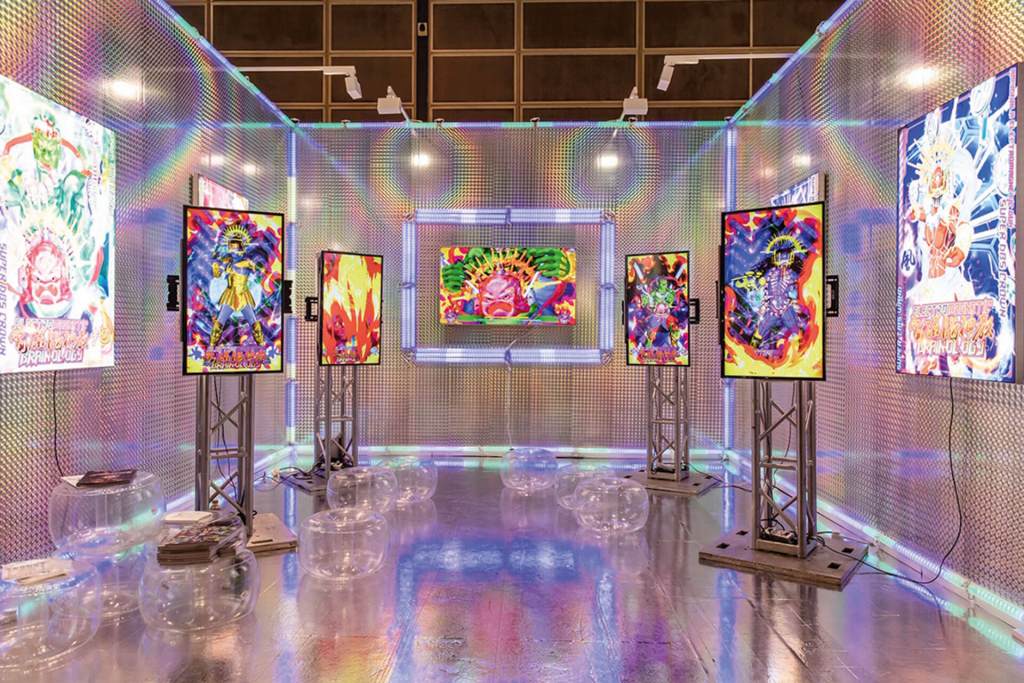
One such artist at the forefront of melding art and technology is Lu Yang, with works widely exhibited at UCCA, Beijing, Centre Pompidou, Paris, and the 56th Venice Biennale 2015 China Pavilion. Through the medium of video, installation, and performance, the artist connects the religious, scientific, and digital, with aesthetics drawn from popular youth culture, creating new visions of China in the face of modernity.
In the case of Lu’s Electromagnetic Brainology! (2017), a five-channel video, inspired by Hinduism and Buddhism, digital avatars of reimagined deities respond to the four major afflictions of the nervous system, which in turn represent the four elements of the universe – earth, air, fire and water.
Pain is received by the deities in the video work via DBS technology. This is a widely practiced surgical practice when the electrode is planted in the brain of the patient, making use of a pulse generator to stimulate the nerve nucleus deep inside the brain, correcting the abnormal network.
Thanks to ‘superpowers’ relating to advances in neuroscience and new medical technologies, the contemporary ‘gods’ can theoretically control neurological conditions such as anxiety and depression, reimagining a whole new way of dealing with the most common aspect of being human – pain.
Acquired by DSLcollection in 2020, Electromagnetic Brainology! (2017) is one of the most fascinating works of Lu’s oeuvre, aligning with the Levys’ interest in collecting art that explores complex, contemporary issues.
Moreover, Lu’s interdisciplinary approach of blending neuroscience, religion, and pop culture, coupled with the ensuing global popularity of such artworks, speak to a specific hunger in our current cultural desert.
Luxury Brands And Museums Fall For Chinese Art (And Collectors)

Over the past few years, major museums have begun taking Chinese artists and their works seriously. When Hong Kong’s newest museum for visual culture, M+, opened in 2021, it unveiled the world’s most comprehensive collection of Chinese contemporary art, going all the way back to the seventies.
Luxury brands are also getting in on the action. While Paris’ Centre Pompidou has been collecting Chinese contemporary art since 1976 – an assemblage of 150 works by 58 artists – last year, the museum acquired 21 works by 15 Chinese contemporary artists with the backing of French luxury fashion house Chanel.
It is the Paris institution’s largest single purchase of works from the country, expanding its collection of contemporary Chinese art by nearly 20 percent.
The acquisition was in conjunction with the launch of the exhibition, “目Chine, une nouvelle génération d’artistes,” ahead of Art Basel Paris 2024, featuring 53 works by 21 artists born from the late 1970s to the early 1990s. The largest exhibition on Chinese contemporary at Centre Pompidou since 2003, it is reportedly “the fruit of the Paris institution’s partnership with West Bund Museum in Shanghai, which was renewed for another five years in 2023.”
It is not so far-fetched to imagine more renowned international art institutions and luxury houses coming together to recognise Chinese artists and their immeasurably nuanced body of work, especially given increasing economic turbulence.
For one, the luxury market in China is lagging and US President Trump’s tariffs do not bode well for Chinese consumer demand. In fact, China has been described as a “thorn in luxury’s side, down 20 per cent year-on-year on a constant basis,” and if the country had been excluded from the end of year projections by management consultancy Bain and Italian luxury association Altagamma, the luxury market “would have been growing” in 2024.
Yet, the Art Basel and UBS Survey of Global Collecting revealed that art and antiques spending by around 300 high net worth collectors from mainland China in 2023 and the first half of 2024 was more than double of any other region at a median value of $97,000. France was in second place at $38,000, Italy at $32,000, the UK at $31,000 and Hong Kong at $28,000.
Noah Horowitz, CEO of Art Basel, told The Art Newspaper that this finding “flies in the face of what we read anecdotally” about Chinese buying slowing since the pandemic but aligns with “strong attendance of Chinese and Asian VIPs” at Art Basel Paris last year.
He described these buyers as established Gen X collectors “who are quite possibly looking at where there are opportunities of well-priced material and looking to really lean in now in the face of a degree of market softness.”
(Not) An Epitaph For Art Collecting In The 21st Century
It is blatantly clear economic, technological, and geopolitical shifts are happening on the daily, and the art world is very much impacted by these changes, be it international tariffs inciting further economic challenges or DEI bans likely to render the most established western art institutions insular beyond recognition or the highly-contested advent of AI.
What is even more clear is that the art world, with its hyper-obsessed focus on the status quo, is not remotely prepared for the degree of economic and social turbulence currently wrecking its eco-system. Even regions and cities, beyond established capitals, are not exempt, struggling to balance the interests of western businesses and institutions looking for a financial buoy, against those of talents closer to home who possess far more breakthrough potential and cultural relevance.
Let’s not mince words. This is not merely an essay on an art collection but a glaring indicator of what it takes to be at the forefront of a global eco-system that is barely holding itself together.
Like DSLcollection, those who wield wealth and technology are obviously better equipped to lead the way. Firstly, by shedding light on art and art scenes often misunderstood or ignored in our fragmented global discourse. Secondly, by grasping the urgent need for experimentation amidst cultural stagnancy, be it interdisciplinary collaborations or new and sustainable technology.
To be honest, such an approach is the bare minimum, given the scale of crises we are facing today. However, there remains a naive yet wilful hope that DSLcollection, and many more of their kind, across diverse geographies, will rise to the occasion.
You can explore the other essay in this commissioned (paid) series here.
 Art Industry Insights With Reena Devi