In this trilogy of original, non-commissioned, and unpaid essays published by Art Industry Insights With Reena Devi, arts journalist and editor Reena Devi explores our collective capacity to critique, to create, to advance, even as the very foundations of our public and creative life collapse and collide.
For exclusive updates on Art Industry Insights With Reena Devi, you can become a one-time or regular supporter.
You can also follow the independent media on Substack or Instagram. Commissions, tips, and leads are more than welcome.
When leading Saudi artist Ahmed Mater debuted his solo show at UCCA Edge, Shanghai, as part of Saudi-Chinese Cultural Year 2025, it signified more than soft power guised as a cultural milestone.
His artistic foray into China hinted at a centuries-old tradition of Eastward curiosity, now resurfacing in a rapidly multipolar world.
How The Ottomans Mapped New Worlds
In 1520, the first Ottoman explorer Ali Akbar Kata’i published a memoir of his travels to China titled the ‘Khataynameh’. His writing on Chinese politics, history and geography would be “unmatched in Europe for another century.”
That very same year, an anonymous author wrote the Vakaiat-i-Sultan Cem, said to be “the earliest known narrative of travel in Europe ever to be composed in Ottoman Turkish.”
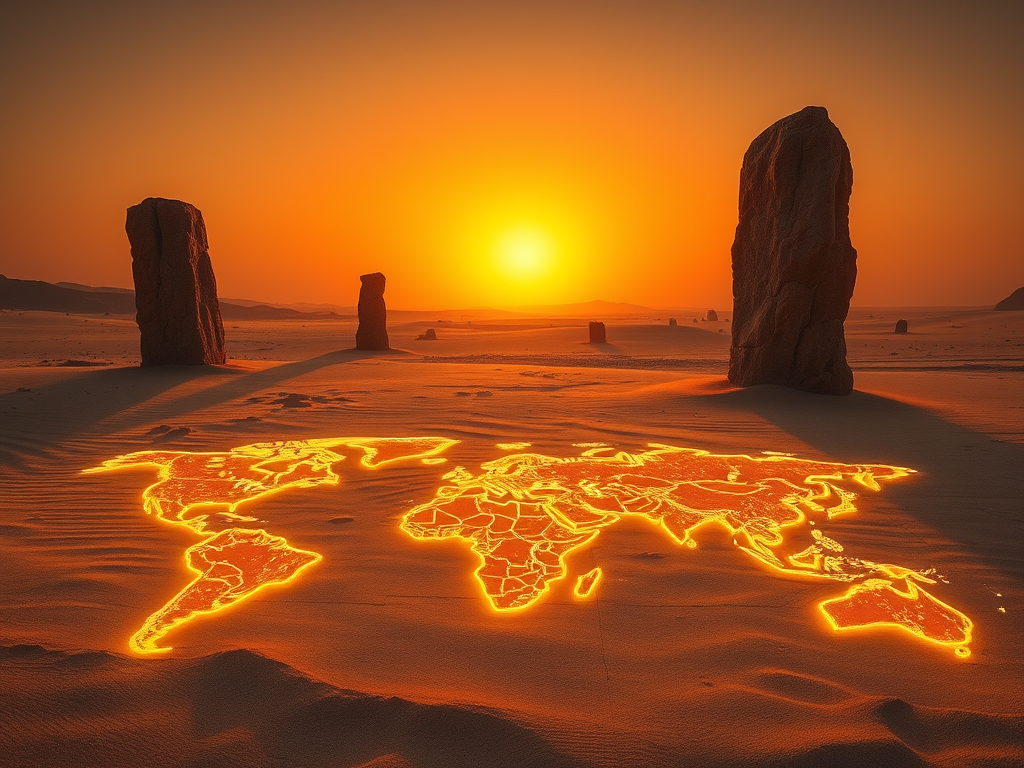
In fact, the Ottomans’ appetite for the world beyond can be traced back to the Piri Reis World Map of 1513, among the “earliest cartographic visions” of the New World, compiled by Ottoman admiral and cartographer Piri Reis.
The map painter reportedly wrote: “I have made maps in which I was able to show twice the number of things contained in the maps of our day, having made use of new charts of the Chinese and Indian Seas which no one in the Ottoman lands had hitherto seen or known.”
While these maps and books were definitely fodder for the imperial ambitions of a growing Ottoman Empire, they bring to light a model of the world that is multipolar, uneven, and constantly being crafted through centuries of human history till today.
The curiosity that drove Ottoman cartographers and chroniclers to distant lands echo in current artistic exchanges within the Global South, epitomising cultural ambition that exists outside the binary of East vs. West.
The Gulf Charts New Paths In The Sand
As far as global headlines are concerned, the Gulf States are primarily focused on partnerships with established yet struggling western art world institutions. However, in the face of shifting political alliances, the United Arab Emirates, Qatar, and Saudi Arabia are also looking towards East Asia.
From inviting senior museum staff for biennale opening weekends to sit-down interviews to artistic director appointments to biennale pavilions to museum exhibitions, the Gulf countries are engaging with the leading art capitals of East Asia on every possible front.
Even Saudi Arabia, far more focused on developing local talent than tapping on Global South diasporic communities like its neighbours Qatar and United Arab Emirates, is getting in on the action.
This August, the latest edition of Art Bridges, a cultural exchange by Saudi Arabia’s Visual Arts Commission, was announced. It provides artists and practitioners living in the Kingdom the opportunity to develop and showcase their practice abroad, including immersive visits to Japan and South Korea.
It does seem that even during the ongoing rise of isolationism and protectionism, be it in the form of tariffs or immigration laws or struggling refugee systems, art, ideas, and people continue to flow across borders.
Nonetheless, it is worth considering – are the cultural ties developing between various parts of the Global South solely imitating the modern machinations of Western soft power? Or potentially nurturing alternative creative infrastructures rooted in shared yet nuanced decolonial experiences?
After all, the most potent artistic forces today appear to be emanating from creative grassroots ecosystems in places long looked upon with an imperial eye.
The Rage We Feel When Unmapping The Empire
Amid the recent hubbub of Frieze Seoul 2025, a specific gallery show stood out. Running since August, ‘Artificial Elegance’ is a curatorial collaboration between Jungmin Cho, founder of prominent Seoul art gallery White Noise, and Junni Chen, Deputy Director at Hong Kong’s leading contemporary arts centre, Para Site.
Speaking with Art Industry Insights, Cho said, “When Junni Chen and I spoke, we found deep resonance in our discussions about the social conditions of Asian women and the collective rage expressed through movements like 4B, which has recently gained international attention.”
“This led us to reflect on contemporary feminism in the context of labor and technology, and to consider how feminized labor, which we define as irregular working hours, emotional labors and microworking, has become a widespread condition—transcending gender, age, and geography,” she added.
With countries free falling into technofeudalism, ‘Artificial Elegance’ comes across as fiercely relevant. The exhibition features moving image, installation, and mixed media works by Jen Liu, Sylbee Kim, Haena Yoo, as well as artist duo lololol comprising Xia Lin and Sheryl Cheung.
The artists hail from Korea, Taiwan, Germany, and America, expressing diasporic and rooted voices of East Asia.
The Stories We Tell When Unmapping The Empire
Then, there’s Colomboscope, an interdisciplinary arts festival in Sri Lanka, steadily gaining a presence within the Global South cultural landscape since 2013. Its latest edition, ‘Way of the Forest’, was held across various venues in Colombo in January 2024 before travelling to Abu Dhabi’s 421 Arts Campus last fall.
Thematically inspired by Ursula K. Le Guin’s anti-colonial, environmental, sci-fi novel ‘The Word for World Is Forest’ (1972), the festival was led by Colomboscope artistic director Natasha Ginwala, along with co-curators Hit Man Gurung, Sarker Protick, Sheelasha Rajbhandari, and Vidhi Todi.
Notably, Ginwala was appointed to the curatorial team for Sharjah Biennial 2025, the Gulf region’s most established contemporary art biennale.
Showcasing “the urgent practices of artists from Sri Lanka and beyond,” key works at Colomboscope 2024 included Hidden (2023), an evocative installation by Arulraj Ulaganathan about the lives and hardships of Tamil tea pickers working in a plantation on the central hills of Sri Lanka, and a three-channel video work Arslanbob (2023) by Saodat Ismailova, tracking the journey of a date seed from a religious preacher to “the mouth of 12th-century Central Asian mystic Ahmad Yasawi.”
Exhibitions like Colomboscope, at least at the grassroots level, tend to actively explore on-the-ground social malaises and go beyond Western gatekeeping. However, they are not entirely immune from entrenched systemic violence and socially conditioned biases.
What We Drew Before We Had Borders
Are such artistic exchanges, helmed by governments and independent art entities alike, truly decolonial, or just rebranding the same elite circuits? Who decides who gets to show their art and ideas to the world? And, crucially, who benefits in the creative exchange?
These questions possess a historical urgency in this epochal moment, as we reimagine our cultural spaces amidst political, economic, and existential turmoil. We are not so dissimilar from our ancestors carving out their sacred and storied spaces between collapse and continuity.
Over 11,000 years ago, long before the rise of empires—during one of the most momentous transitions in human history—the megalithic structures of Göbekli Tepe were built by hunter-gatherers.
The discovery of this ancient site and its buried structures in modern day Turkey highlighted the art, architecture, ritual, and communal exchange which transpired when we transformed from hunter-gatherers to the first agricultural communities.
Like the Ottoman cartographers, or the artistic collaborations of our fractured age, the architects and artists of Göbekli Tepe exhibit an enduring human tendency, an ancient impulse to expand beyond what is known and familiar.
But their art was most likely not about imperial branding—it was primal storytelling and collective identity shaping. Can we truly say the same for ours?
Explore other non-commissioned (unpaid) essays in the completed series here.
Support independent arts writing here.
For exclusive updates on Art Industry Insights With Reena Devi, you can become a one-time or regular supporter.
You can also follow the independent media on Substack or Instagram. Commissions, tips, and leads are more than welcome.

 Art Industry Insights With Reena Devi