Anatomy Of A Dead Pitch is a brand new, ongoing series of critical essays published by Art Industry Insights with Reena Devi.
Arts journalist and editor Reena Devi uses an exhibition, art event, or artwork, which was ignored or declined for commission and publication, as an incision point for a painfully nuanced post-mortem of today’s fragmented world. [1]
Please be warned. This is a series that bleeds. There is no formaldehyde here.
This critical essay is non-commissioned (unpaid) so if you believe in independent journalism that dares to speak from the margins, please support the work.
An Exhibition On Rejection
“I think suffering will become more visible,” Francisco Berzunza, Mexico City-based curator and historian, uncannily predicted in a December 2023 interview.
His upcoming exhibition this fall at the Museum of Mexico City attempts to explore the notion of rejection across personal, historical, and political registers.
The ambitious group show, ‘Broken Column’, is set to feature work by diverse contemporary artists, from Chilean artist, architect, photographer and filmmaker Alfredo Jaar’s site-specific facade projection, marking the corner where Aztec King Montezuma and Spanish conquistador Hernán Cortés first met, to weekly performances by Lagartijas Tiradas al Sol, Mexico’s leading experimental theatre collective.
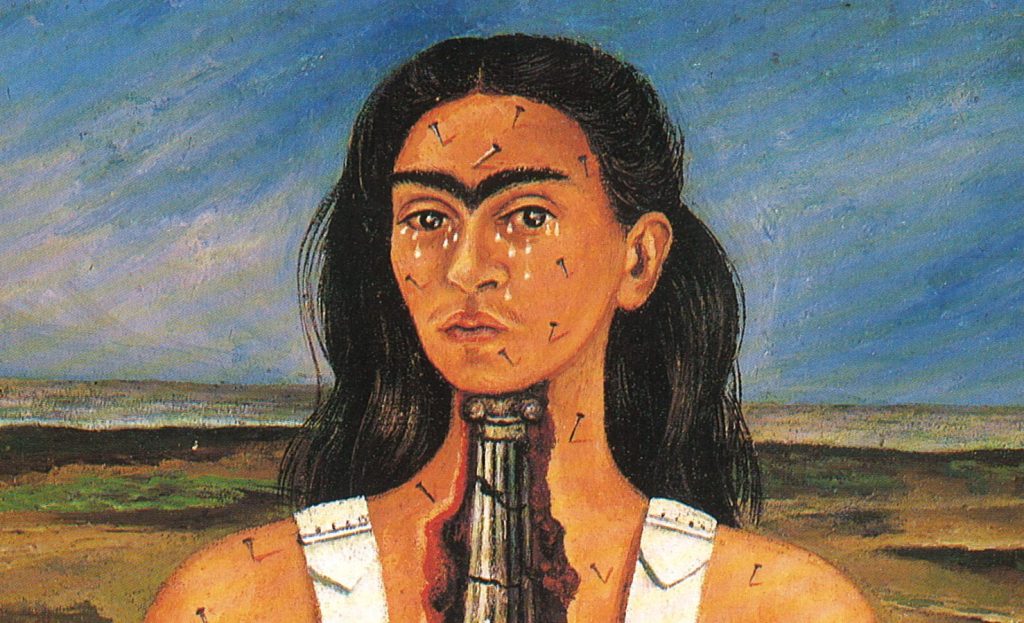
However, the exhibition’s key artwork is slated to be Frida Kahlo’s 1944 drawing, Preparatory Sketch for The Broken Column, which also lends its name to the show, riding the wave of Kahlo’s renewed popularity.
Her resurgence is more than mere market machinations—Kahlo’s work, primarily about pain and suffering, resonates amidst crises and collapse.
The Broken Column (1944) encapsulates the artist’s anguish shortly after a spinal surgery to correct injuries from a terrible accident when she was 18. In the self-portrait, nails are stuck into her face and whole body, her torso split like an earthquake fissure, the earth filled with dark ravines in the background.
One of the most visceral experiences of mortality is when your own body finds ways to reject you, and Kahlo definitely processed these painful experiences in her art.
Beyond the physical body, toxic pathogens of rejection and erasure have long been reflected in extremism, violence, loneliness, disconnection, and displacement. At this moment in time, rejection seems to be the only language the world speaks, and yet somehow, barely comprehends.
The exhibition ‘Broken Column’ may or may not make headlines but its themes—pain, rejection, suffering—are already bleeding into everything around us.
Rejection In The Era Of Extremism

Any discourse on rejection today warrants a closer look at the far-reaching, momentum-gaining social malaise, known by a cacophony of terms, from “manosphere” to “internet-bred incel”.
Using their alleged eloquence and elite credentials to legitimise extremist views, leading personalities like Jordan Peterson and Andrew Tate effectively persuade younger men, whose only real exposure to the world is online.
Through 4chan, Reddit, Discord, and other similar online communities, messaging apps, and forums, young men across the world gather anonymously to commiserate about feminism and what they consider reverse discrimination.
The online discourse severely lacks emotional and mental frameworks to process any kind of rejection faced by young men in their own individual lives, primarily teaching them how to project and lash out externally.
Chillingly, the slang or beliefs from such discussions have manifested as traumatic physical violence enacted by men, proliferated mainstream media and politics, all while tapping into entrenched patriarchy within developed societies like US, UK, and South Korea. Even less political divisive countries such as Singapore are not exempt.
While the overwhelming sense of male victimhood underlying widespread physical and verbal violence is terrifying, the vulnerability of young people online is a mitigating factor. This is, in part, due to their growing propensity to spend time alone, as compared to previous generations.
Technological Commodification of Loneliness
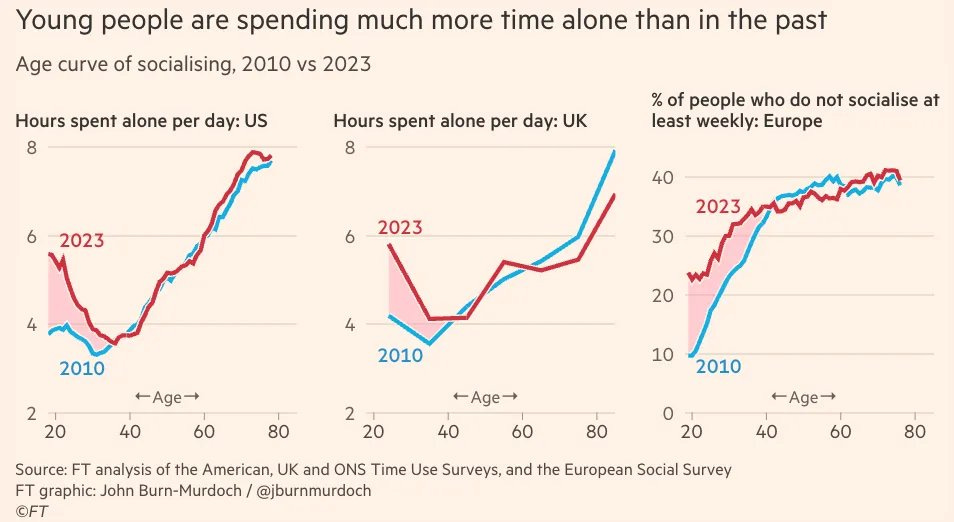
In January 2025, Financial Times reported that a “marked shift away from in-person socialising could explain a substantial portion of the decline in young people’s wellbeing.” Observed across US, UK, and Europe, this trend was notable amongst young men.
Technology is often cited as a key influence in engendering social disconnection and pervasive loneliness. If rejection is the core wound, technology is the salt.
However, the titans of technology are very happy to embrace endless profit possibilities by selling supposed solutions for the social rupture engineered by their very own platforms, expanding the “loneliness economy”.
Take for example, Meta CEO Mark Zuckerberg’s pitch to create personalised AI friends to complement real life ones: “The average American has 3 friends, but has demand for 15.”
“AI mirrors you. You’re being sold back to yourself. It will only increase hyper-individualism and isolation,” stated Samantha Rose Hill, author and associate faculty at the Brooklyn Institute for Social Research.
After all, if the world no longer accepts you, maybe AI will do so. Or, even better, the underworld of algorithms can tell you who you are.
“Gen Z’s ‘algorithmized self’ isn’t a choice, it’s an adaptation to systems where viral moments outweigh career loyalty and where institutional stability has been replaced by algorithmic opportunity,” observed Kyla Scanlon, American economic commentator.
“The paths to wealth and meaning have been fundamentally restructured by technology,” she added in her February 2025 newsletter issue aptly titled, ‘Gen Z and the end of Predictable Progress’.
To Scanlon’s point, a recent study by Stanford University found that entry-level workers under the age of 25 are most at risk of losing jobs to AI.
Older workers can rely on their years of hard-won, on-the-job experience for now, but unless they “purposefully invest in challenging tasks that will challenge their brain to connect complex ideas, wrestle with moral ambiguities,” they could also be facing similar risks.
The Art Of Disconnection And Displacement

Seeping into our collective consciousness, across generations, there is a sense that each of us are currently standing outside a house with all of its doors and windows sealed shut.
This is the kind of rejection, insularity, and isolation that has very little to do with consent, respect, or setting healthy boundaries and creating space to be.
Across arts and cultural spaces, rejection is most visible today in the increasing de-prioritisation of creative labour and cultural innovation.
From an emerging arts festival in an overlooked country losing its corporate and government funding within the span of a week to a previously expansive shophouse gallery in a globally attractive city shrunk down to the size of a studio flat, the evidence is everywhere, if you dare to look.
Conversely, art could be where we find the answers and the means to process rejection and loneliness, without technological enmeshment, extremist vitriol or violence.
When cheorographer, dancer, and filmmaker, Bilal Allaf was struggling during a nanotechnology degree in Germany or feeling disconnected from himself as he studied and worked in film, he turned to dance. When he was living with his parents during the pandemic, he turned to dance again, filming himself and posting the videos online.
“I didn’t think dance and performance arts would have a place in Saudi Arabia. I never even mentioned that I had received training to dance. I didn’t think it would be controversial, I just thought it was irrelevant. But I was approached for a performance at the Saudi pavilion at Dubai Expo 2020,” Allaf told CairoScene.
More recently, at this year’s Islamic Arts Biennale organised by Diriyah Biennale Foundation, he embarked on a mediative walk across a rocky valley outside Jeddah for 24 hours as part of a performance art piece.
Then, there’s multidisciplinary Korean artist Kim Sangdon who comes from generations of shamans, after his grandfather turned to the spiritual practice following his experience of displacement during the Korean War.
Earlier this year, Sangdon exhibited his folkloric painting series Egg That Has Spent the Night (2024-2025) at Sharjah Biennial, organised by Sharjah Art Foundation.
His seminal work, showing this month onwards at Hong Kong’s PHD Group, reflects the belief that spirituality can dissolve the violence of borders, birthing new, resilient ways of being across generations.
Where Is The Resistance?
Continents apart, Allaf’s and Sangdon’s responses to personal and generational pain offer a counternarrative to algorithm-driven isolation and the violent weaponisation of rejection. Yet, these are the artists or the art we rarely hear about today.
When will we take such artists, their labour, and their art—from Kahlo’s fissured body to Allaf’s isolated dancing to Sangdon’s ancestral healing to many more—as a serious call to action?
Presently, South Korea is known for its widening gender divide, toxic masculinity, 4B movement, accelerated global soft power, arising from modernism shaped by colonisation, war, industrialisation, and rapid wealth gains.
However, a lesser-known fact is that Korea has over 300,000 shamans, likely drawn to the notion that the rootlessness of being a refugee is not so dissimilar from the ideas of “boundary expansion” and “shapeshifting” in shamanism.
The works of artists like Sangdon and Allaf present a challenge to the art world, and every other interconnected world, to expand their boundaries and shapeshift beyond institutional and algorithmic dictates.
Perhaps, by doing so, we can finally create a forcefield that unflinchingly screams ‘yes’ when a broken civilisation says ‘no’.
Cited By:
1. United Arab Emirates-based journalist Katy Gillett in her popular Middle East media industry newsletter Desert Prose, 12 October 2025.
[1] Explainer for those unfamiliar with the internal workings of media pitching, commissioning, and publication process:
- Independent journalists and freelance writers regularly pitch story ideas to local, regional, and international media outlets they contribute to consistently, on an ad-hoc basis, or hope to work with in the future.
- Freelancers’ pitches may come from their own research or network leads, but increasingly originate from public relations (PR) firms representing organisations, individuals, or projects.
- Once pitched, stories are accepted, ignored, or declined for various reasons — often editorial, but more commonly financial, especially in today’s shrinking media economy.
- A rejected pitch might still be reassigned to in-house staff, a less-costly freelancer, or someone already on the ground. Still, more often than not, a dead pitch is just that — dead.
Then again, when it comes to feeding the beast that is media, anything is possible.
Stay tuned for more in this ongoing series.
This critical essay is non-commissioned (unpaid) so if you believe in independent journalism that dares to speak from the margins, please support the work.
Future essays in this series may be commissioned (paid) and will be disclosed accordingly. They will not include the Buy Me A Coffee link.

 Art Industry Insights With Reena Devi